The AI Adoption Roadmap for Small and Mid-Size General Contractors
If you're running a general contracting business and trying to figure out where AI fits, you've probably hit the same wall most GCs hit: you know you should be using AI more, but you're not sure where to start.
The software vendors are pitching you platforms. The big consulting companies are pitching you transformations. You're trying to run jobs, manage subs, and keep your margins intact. Competing priorities leave you with more questions than answers. This guide can be your map.
Do small and mid-size general contractors need AI?
We might be biased, but we think everyone should be adopting AI. And the case is stronger for you than it is for large GCs.
Large companies have dedicated admin staff, project controls teams, and software budgets that absorb inefficiency. You don't have the same luxuries. Every hour your project manager spends on documentation is an hour they're not managing the job. Invoices that take three days to process create three days of cash flow delay. And meetings that go undocumented become decisions that only live in people's heads.
The reason mid-sized GCs can get an outsized advantage with AI is simple: you can do more with the same team. A 20 or 30-person GC can double their capacity with AI when properly implemented.
The GCs that will have a cost advantage in five years are the ones building AI-native operations now. They're compressing the time their best people spend on low-value work, so the firm as a whole gets significantly more productive.
How long does it take to implement AI for a general contractor?
Your first workflow can be live in 4 to 6 weeks. A full AI adoption rollout, where AI is embedded across your core operations, takes 6 to 12 months.
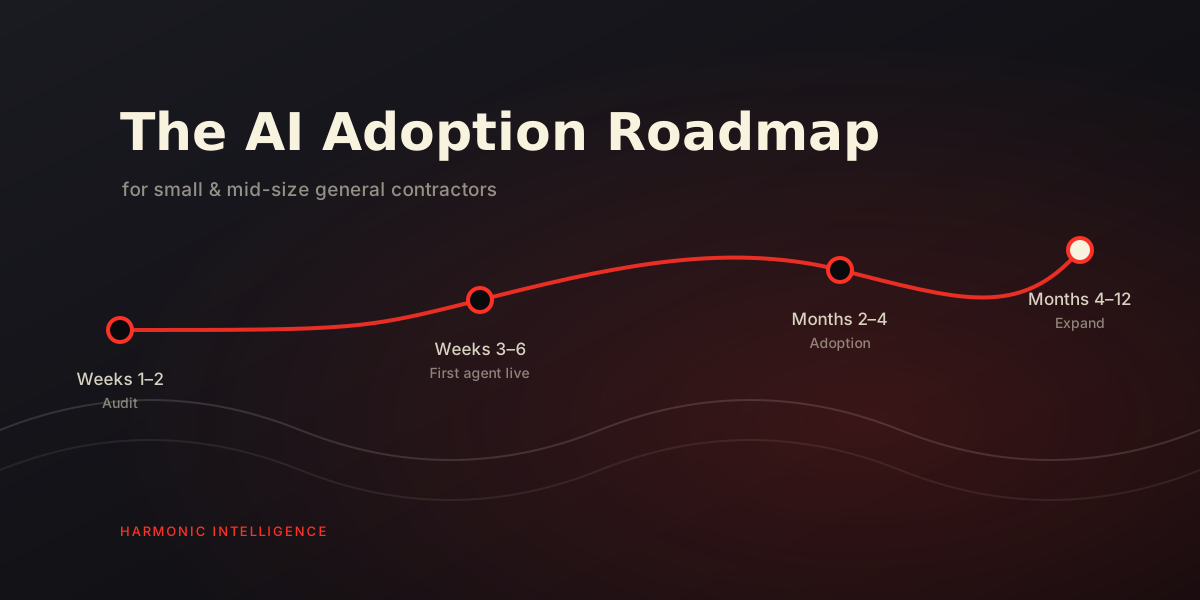
Weeks 1-2 are a workflow audit. Before you build anything, you map your operations: which workflows eat the most time, where the biggest bottlenecks are, what's costing you money that shouldn't be. A good AI adoption partner will do this with you, not for you, because the person who knows where the real pain is tends to be the one doing the work.
Weeks 3-6, your first agent goes live. You pick the highest-value workflow. For most GCs that's invoice processing, meeting documentation, or quoting support. You structure the data and get a live system your team is using for real work.
Months 2-4 are about team adoption and iteration. Getting the agent live is the easy part. Getting your team to use it is where most AI projects fail. This phase is about training, feedback loops, and adjusting the system based on how it performs in the real world.
Months 4-12, you expand to additional workflows. Once one is working and your team trusts it, you move to the next. By month 12, AI becomes the go-to tool for the tasks it does best.
How much does AI implementation cost for a general contractor?
There's a wide range, so here's what drives the cost.
Off-the-shelf AI tools run $50-500/month: transcription tools, ChatGPT, AI features in your existing PM software. These are low cost, require limited customization, and have minimal onboarding, so you're largely on your own to figure out how to use them.
Custom AI agents for a single workflow typically run $5,000-$45,000 built in phases, depending on complexity and integrations. This is what Harmonic Intelligence focuses on: agents built around your specific systems and processes, not a generic product.
A full AI adoption program covering multiple workflows and company-wide training ranges from $30,000-$100,000 depending on scope.
The results math on custom agents is usually straightforward.
Example 1: Invoice Processing. If your admin team costs $50/hour and spends 10 hours/week on invoices, that costs you $2,000/month. Cut that to 2 hours/week and you've saved $1,600/month. A $10,000 build pays for itself in less than 7 months.
Example 2: Bidding & RFQs. If you can delay hiring a junior estimator at $70,000/year while bidding on more projects, a $25,000 project breaks even in 3.5 months.
Financial ROI is only one factor to consider. Developing AI skills on your team and adopting an operational efficiency mindset pay dividends over time.
Talk to us about your first workflow →
Which AI workflows should a GC prioritize first?
Not all workflows are equal. Start by looking at your company's strategic priorities over the next 6-12 months. What are you trying to achieve? What bottlenecks are holding you back from achieving your goals? The workflows worth automating first are the ones that hold you back and are high-volume, repetitive, and can be clearly explained to a new employee joining your firm.
Many GCs start with bidding, invoices, and field reports. These are high volume, with clear formats and straightforward logic. Bidding and RFQs are the most common first build for GCs and consistently deliver quick results. Invoice processing and field reports follow the same pattern: structured inputs, predictable output, verifiable definition of done.
Other workflows, such as RFIs and submittals, can be high value automation opportunities as well. Some have great off-the-shelf solutions, while others are more suited for custom builds. That's why mapping out your unique business needs is usually the best place to start.
What are the risks of AI adoption in construction?
Construction is an inherently risky industry. While adopting AI brings its own risks, it also reduces in other areas of the business.
Team resistance is the most common failure mode. You build the agent, it works, and nobody uses it because it doesn't solve a real problem, it wasn't introduced properly, or your team doesn't trust it. The fix is designing the solution with your team so it solves their biggest challenges, not building it and hoping they'll use it.
Poor quality data is another problem. AI is only as good as what you feed it. If your file names are inconsistent, your meeting notes are incomplete, or your job data is messy, your agent won't know what it's looking at. A workflow and data audit upfront surfaces these issues before they become problems.
Massive, cross-functional rollouts usually start with a bang and fizzle out quickly. Starting too big and trying to transform your whole operation at once almost always leads to stalling out. Start with one workflow, prove it works, then expand.
Vendor dependency matters more than it looks going in. If an AI company builds you a system and then disappears, you're stuck when something breaks or needs to change. Make sure whoever you work with either stays on to maintain the system or trains your team to do it themselves.
The risk people worry about most, AI replacing their people, isn't the practical one. Getting out of the starting gate with AI is where most companies trip up.
How do construction companies measure AI success?
You don't need a complicated measurement framework. The metrics that matter are the same ones you already track.
Hours saved on the automated workflow. If invoice processing used to take 8 hours a week and now takes 1, that's 7 hours back.
Error rate on the workflow: are invoices getting approved with fewer mistakes, are meeting action items getting missed less often?
And team adoption rate: how many people on your team are using the tool? How often?
Track these for 60 days after go-live. If the numbers aren't moving in the right direction, either the agent needs adjusting or the rollout does. A good partner stays engaged through this phase.
Your AI adoption roadmap: the short version
For a GC with 10-500 employees, here's how you can get started:
Look at your strategic priorities. What processes, paperwork, or problems are holding you back from achieving them?
Spend a week mapping your workflows. Where do your time and money go? Involve your PMs, admin, estimators, and supers rather than assume.
Pick one workflow. The highest-volume, most repetitive process that has a clear format and impacts your strategic priorities.
Build it. If you're doing it internally, don't make it side-of-desk. Give the best builder you have 1-2 weeks of focused effort.
Train your people. Show your team how it works, why it makes their job easier, and what to do when something looks wrong.
Measure for 60 days. Hours saved, errors caught, and adoption rate. Adjust based on what you see.
Once one workflow is working, expand from there. Once you've done three, AI becomes a part of how your company operates.
Talk to us about your first workflow →
Harmonic Intelligence is an AI adoption consultancy built for construction and real estate. We help GCs and real estate firms become AI-native through strategy, custom agents, and training. Learn more at harmonicintel.co.